
ACCENT HOME IMPROVEMENTS
One event. Honest observations. Give the water record a date and a location.
A rain observation record connects a particular event with the exterior area and views you actually have. It can help explain a gutter, roof-edge or patio question without guessing a cause or claiming to measure the entire property’s drainage. Use this guide to organize an honest record for an exterior enquiry with Accent Home Improvements in Greater New Orleans. Official weather safety and access instructions come before obtaining any photograph or filling a missing entry.
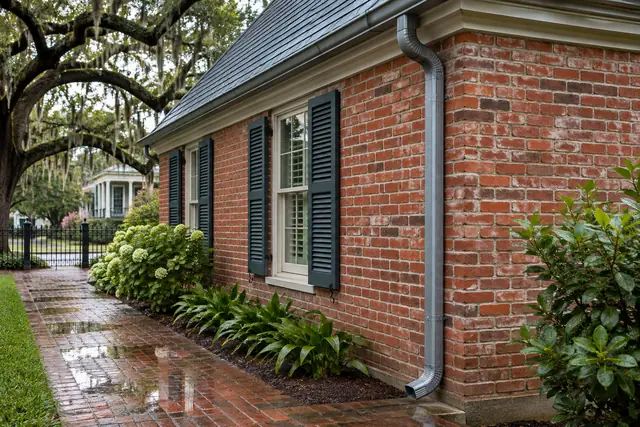
Put weather safety before the observation record
The National Weather Service says to seek safe shelter when thunder is heard and to stay away from porches, windows and doors during lightning. Do not remain outside or choose a hazardous viewing position to complete this record. Use existing information and add ordinary views later when conditions and access are appropriate. A missing image can remain missing. This page does not establish that a roof edge, patio or route is safe to approach. Its purpose is to organize what was actually observed, not direct an inspection during severe weather or encourage a better photograph at the expense of official safety guidance.
Give the event an honest date and reference
Start with the date and the property location. Record the approximate time or stage of the event only if you actually know it, identifying estimates and recollections as such. A photograph taken later should retain its later date rather than be presented as a view during rainfall. If you are combining notes from more than one day, keep separate event entries. Do not invent rainfall totals, intensity or durations to make the account seem measured. The useful record explains which event the observation belongs to and what information is available, while preserving uncertainty about details no one recorded.
Place the observation on the building
Identify the relevant roof edge, downspout, patio boundary or path using a location name that can be reused in an enquiry. A wider ordinary view can help show where a detail belongs when one is available. Keep the original image unchanged and add arrows or route marks only to copies. If an observed route disappears from view, stop the description at that point instead of drawing a concealed continuation. The record should show what was visible from the available position, not imply that the household traced every connection or evaluated the property’s full drainage arrangement. Leave inaccessible areas as questions for appropriate assessment.
Describe the visible sequence without diagnosing it
Write what was noticed and in what order, separating direct observation from later recollection. A note can say that water was visible beside an identified corner in a later photograph; it should not automatically declare which component caused the condition. Timing and proximity alone do not prove the source, hidden extent or correct repair. Keep any actual assessment with its author and document date. If the observation concerns more than one location, give each its own entry rather than mixing them into a single claim about the entire house. An accurate sequence can remain incomplete while still helping the next conversation.
Use the event fields to keep notes consistent
The fields below form one event entry. Add the actual date, location, available view and plain observation, then record unknown details and the question you want clarified. Keep a photo reference that another person can match to the location. If the only record is a later view, say so explicitly. A short consistent entry is more useful than a large folder of unlabeled images accompanied by a confident explanation that the evidence does not support. Repeat the entry for another event instead of overwriting the earlier record. This preserves the distinction between an observation that recurred and a single event remembered in different ways.
Your working record fields
- Event reference and date
- Separate entry for each known event.
- Time or stage
- Actual information, estimate or unknown clearly identified.
- Property location
- Stable roof edge, corner, patio or path label.
- Available view
- Photo date and whether it was taken later.
- Visible observation
- What was seen; the route stops where the view ends.
- Unknown detail
- Missing view, concealed connection or unrecorded timing.
- Service question and response
- Requested clarification and actual dated source reply.
Keep later ordinary views as separate records
A later photograph may show the same area under different conditions. Retain its actual date and describe its limited relationship to the earlier event. Note any known work through the actual source documents and identify changes in angle or lighting where relevant. Do not infer everything that happened between two pictures. If a provider supplies an assessment or proposed work, keep the full document separately and reference the event it concerns. The event record is evidence of the material you actually have, not a substitute for appropriate assessment or a reconstructed account of details that were never observed.
Patios →
Connect the observation to a defined service question
Decide what exterior work or assessment you want to discuss. A gutter enquiry should identify the relevant roof edge or outlet; a patio enquiry should identify the actual outdoor area and adjacent building features. Ask Accent which parts fit its offered services and which questions need another provider. Do not assume that a gutter or cover discussion includes underground routes, grading, every drainage feature or a guarantee that a location will remain dry. Keep those boundaries explicit. The detailed project brief can then describe the requested work, while this event file retains the observation that prompted the question.
Send a concise event summary with the enquiry
Provide the property location, event reference, relevant area and a brief factual description of the question. Include the available original-view references and identify which images were taken later. Ask what additional information or assessment is needed for the requested service. Do not create a new exposure simply to fill an empty field. Keep insurer decisions, official safety instructions and specialist evaluations with their appropriate sources. When a response arrives, attach its actual date and source to the event entry. The result is a clear exterior conversation that preserves what was observed, what remains unknown and which work is actually being considered.
GOOD QUESTIONS. CLEAR ANSWERS.
Your rain observation questions.
Use these answers alongside the assessed conditions and choices for your own property.
YOUR PROJECT · YOUR NEXT STEP
Turn your project ideas into a clear next step.
Share your project and city or ZIP. Accent can discuss the existing space, your priorities and the details needed for an estimate.
- Share your project
A short request. Phone or email. No account needed.
- Review scope and estimate
Discuss the assessed work, materials, preparation and exclusions.
- Approve and plan the work
Confirm the agreed scope and installation arrangements with Accent.
Your request starts a conversation. You approve the work before installation.
